
Pregnancy Calculator to
Check Your Week, Month
and Due Date

The pregnancy calculator helps you find your current gestational age, your pregnancy week and month, your trimester, and your estimated due date.
Choose the calculation method that suits you: last menstrual period, conception date, a due date set by your doctor, or embryo transfer data after IVF. Results are shown in both Hijri and Gregorian calendars.
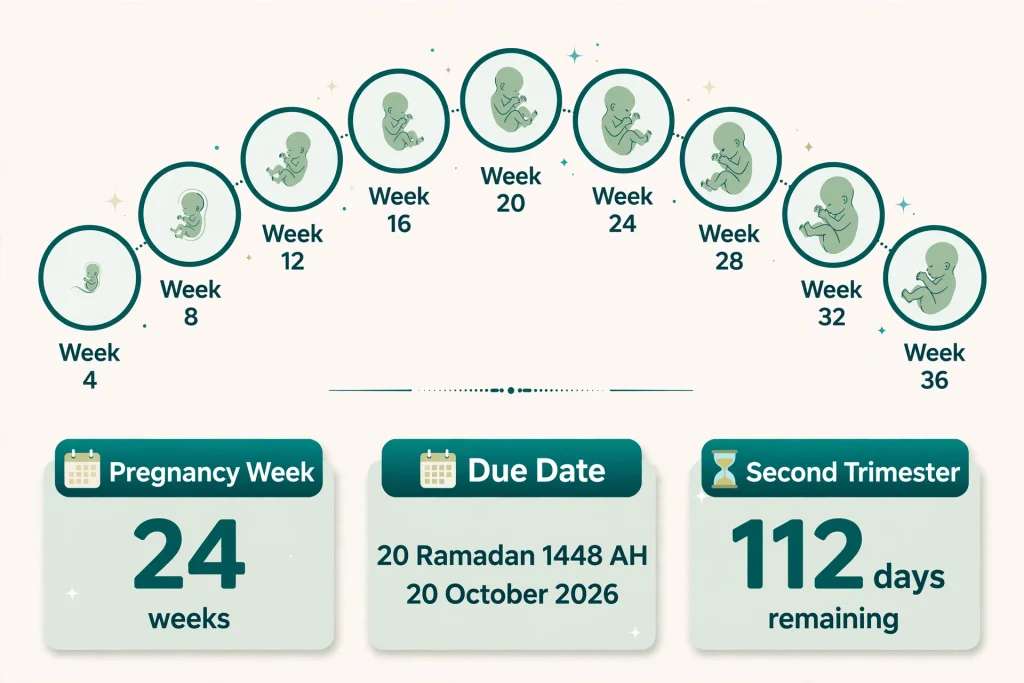
The pregnancy calculator shows weekly fetal growth and the due date.

Accurate Pregnancy Calculator

Choose your calculation method
Calendar for displaying results

Enter your date using the Gregorian calendar. You can display your results in the Hijri calendar based on Umm al-Qura.

✓ Instant results without registration

`;const blob=new Blob([html],{ type:"text/html;charset=utf-8" });const url=URL.createObjectURL(blob); const win=window.open(url,"_blank");if(!win){ URL.revokeObjectURL(url);alert( "Please allow pop-ups to open the printable pregnancy report." ); return; }setTimeout(()=>{ URL.revokeObjectURL(url); },60000); }el("hh-en-print").addEventListener("click",printResults);/* RESET */el("hh-en-reset").addEventListener("click",()=>{ form.reset(); dateInput.value="";el("hh-en-advanced").hidden=true;el("hh-en-advanced-button").textContent= "+ Advanced Options";el("hh-en-advanced-button").setAttribute( "aria-expanded","false" );try{ history.replaceState( null, "", location.pathname+location.search ); }catch(e){}updateMethod();form.scrollIntoView({ behavior:"smooth", block:"start" }); });updateMethod(); restoreSharedResult();})();

The result is an estimate, not a confirmed delivery date, as cycle length, ovulation timing, and the method of dating the pregnancy may vary from one case to another.

Choose the method closest to the information you have in the calculator. Last menstrual period is the most common method: enter the first day of your last period along with your usual cycle length.
If you know your conception date precisely, choose the conception date method. If your doctor set a due date, choose the due date method and the calculator will work backwards to your current gestational age.
After IVF, choose the embryo transfer method and enter the transfer date and the embryo age.

After you press the calculate button, your result appears instantly and includes: your pregnancy week and day, your approximate pregnancy month out of the nine months, and your trimester (first, second, or third).
Your estimated due date appears in both Gregorian and Hijri with the number of days remaining. You will also see your baby's approximate size this week. Your result shows your gestational age in days and weeks together. A full pregnancy is about 280 days.
The daily view shows the day by day details. You can follow it day by day as your result progresses.
If you want to share the result with your doctor or family, use the copy result link button or the Print / Save PDF button from the results panel.

Gestational age is the medical age used to track pregnancy, while fetal age counts the time since fertilisation actually happened. That is why gestational age may appear about two weeks greater than fetal age in a natural pregnancy calculated from the last period.
Knowing this difference helps explain why the calculated pregnancy date differs from the expected conception date.
Read also: Step by step pregnancy and birth guide

Diagram showing the difference between gestational age counted from the first day of the last period and fetal age counted from the time of fertilization, differing by about two weeks

The most common method starts from the first day of your last menstrual period, and pregnancy is usually estimated at about 40 weeks from that date, a manual method also known as the pregnancy wheel.
The About page explains the pregnancy wheel and the calculation methodology step by step. But cycle length and ovulation timing are not identical for everyone.
That is why the tool offers more than one calculation method instead of relying on a single method for all cases.
If you are looking for your pregnancy in weeks, or want to know your weeks, months, and days together, this information appears directly in your result.

Pregnancy wheel diagram showing the correct way to calculate pregnancy from the first day of the last period until the due date after 40 weeks

Pregnancy tracking usually relies on weeks and days because they are more precise than months alone. That is why week based tracking combines weeks and days in the same result, while month tracking helps you know your approximate month out of the nine months.
The pregnancy table shows the approximate relationship between week, month, and trimester, and the weeks to months section explains the conversion simply. If your question is "how many weeks are in a month?", use the table below for an approximate conversion without manual calculation.
Because calendar months do not match pregnancy weeks exactly, weeks remain the clearest reference for tracking gestational age.

Illustrative chart of the pregnancy-by-weeks table showing the conversion between pregnancy weeks and months

Pregnancy table by weeks, months, and trimesters

TrimesterApproximate MonthWeeks
FirstFirst1 to 4
FirstSecond5 to 8
FirstThird9 to 13
SecondFourth14 to 17
SecondFifth18 to 21
SecondSixth22 to 26
ThirdSeventh27 to 30
ThirdEighth31 to 35
ThirdNinth36 to 40

Worked example: if your result is week 20, you are in the fifth month, in the second trimester.

If you know the date of your last period, calculating from the last period is simplest: enter its first day. Many ask "how do I calculate pregnancy from my last period?" The answer is that entering the first day accurately is the most important step.
The traditional last period method usually assumes a 28 day cycle, but you can adjust the cycle length if yours is shorter or longer.
If your cycle is irregular, you can enter your average cycle length in the calculator, a method known as the irregular cycle pregnancy calculator, but remember that entering an average does not necessarily improve accuracy when the cycle varies a lot from month to month.
An early ultrasound may be more useful if the last period date is unknown or unreliable. Unsure of your usual cycle length? Calculate it first with the Period calculator.

The tool supports pregnancy calculation in both Hijri and Gregorian using the same data. Use the Hijri pregnancy calculator to see Hijri dates with the Gregorian date shown beside them for easy follow up.
If your medical follow up is in Gregorian, choose the Gregorian pregnancy calculator before entering the date. Your Hijri due date still appears in the result for those who want both calendars together.
A different calendar only changes how the date is displayed; it does not change your gestational age.
How is pregnancy calculated in Hijri in Saudi Arabia? The calculator follows the Umm al Qura calendar officially used in Saudi Arabia.
The Hijri year is about 11 days shorter than the Gregorian year, so the date may differ by one day from moon sighting in some months.

If you know your conception date precisely, choose the conception date method and enter the date. The calculator will add about two weeks to estimate your gestational age and due date; this is known as the conception date pregnancy calculator.
Remember that a confirmed ovulation date does not pinpoint the exact fertilisation day.
The date of intercourse alone is only an approximation, because fertilisation can happen several days later. This method is also known as the intercourse date pregnancy calculator, and it is useful for calculating your due date from intercourse when the date is known accurately.
Conception day and fertilisation day are the same day. If you track ovulation with home ovulation tests, use the Ovulation and fertile days calculator and record the date closest to conception.

Because the calculator shows results in Hijri, you can see your pregnancy week during Ramadan or the Hajj season directly in your result.
Fasting while pregnant is both a personal and a medical decision: consult your doctor first, especially if you are in the first trimester or suffer from nausea or dizziness. Travelling for Hajj is often most suitable in the second trimester and after consulting your doctor.
After birth, the Hijri calendar helps you track occasions such as the aqeeqah on the seventh day and the end of nifas.
You can also use your result to see whether your expected due date falls in Ramadan or the Hajj season, to plan travel and worship ahead.

If your pregnancy resulted from IVF or ICSI, choose the embryo transfer method in the calculator, then enter the transfer date and the embryo age at transfer (3 days or 5 days).
The tool will calculate your gestational age and due date without relying on your last period, a method known as IVF pregnancy calculation. If the date given by your doctor or fertility centre differs from the calculated result, rely on the medically approved pregnancy dating.

Alongside calculating your due date, this general schedule helps you plan; it is indicative and does not replace your doctor:
Weeks 8 to 10: first visit and confirmation ultrasound. Weeks 11 to 13: nuchal translucency screening. Weeks 18 to 22: detailed anatomy ultrasound. Weeks 24 to 28: gestational diabetes screening. Weeks 36 to 40: weekly visits until birth.


Not sure about your pregnancy yet? Find the right test time and understand your result with the hCG pregnancy test and hormone calculator.

A pregnancy calculator provides a practical estimate to help you determine what stage of pregnancy you are in, but it cannot guarantee the actual date of delivery.

✓
Cycle regularity
✓
Last period date accuracy
✓
Ovulation timing
✓
Implantation timing
✓
Accuracy of entered data
✓
Ultrasound confirmation when needed

So, if you are wondering whether a pregnancy calculator is accurate, it serves as a useful estimate when the input data is correct, but it does not replace medical dating.
To increase accuracy, schedule the test for the appropriate time.
hCG Pregnancy Test and Hormone Calculator

Tools to help you at every stage

Pregnancy Timeline

Follow pregnancy stages and important weeks

View Timeline
A Step-by-Step Guide to Pregnancy and Childbirth

A Step-by-Step Guide to Pregnancy Childbirth

Twin pregnancy guide

Twin pregnancy guide

Common Early Pregnancy Symptoms

Early and Common Pregnancy Symptoms

Find more articles about pregnancy and childbirth on our blogs.

About 280 days, or approximately 40 weeks, is the common basis for calculating pregnancy duration from the first day of the last menstrual period.

There is no exact fixed match between calendar months and pregnancy weeks. The weeks based pregnancy table above shows the approximate conversion between week, month, and trimester in an easy way.

You can use it for an initial estimate, but accuracy drops when cycle length varies notably, so try entering your average cycle length, the method known as the irregular cycle pregnancy calculator, but remember the result remains an estimate when the cycle varies a lot.
In this case an early ultrasound may be more useful to confirm gestational age.

Yes, conception day is the same as fertilisation day. The date of intercourse alone, however, can precede fertilisation by several days, so enter the date closest to fertilisation if you know it, and the tool estimates gestational age by adding about two weeks.

Yes. The due date pregnancy calculator, also known as calculating by due date, gives an approximate backwards estimate of when pregnancy began, but it cannot determine the actual day of conception precisely.

No general tool can guarantee an exact date for every pregnancy. Result quality depends on the accuracy of the entered data and choosing the right calculation method.

Naegele's rule is a traditional method for estimating the due date based on the first day of the last menstrual period. You will find a simpler explanation of it and the pregnancy wheel in the "How is it calculated?" section above.

Because the calculator relies on the dates you enter while the ultrasound relies on actual fetal measurements, and an ultrasound before week 14 is the most accurate for dating. Details are in the section above.

Use the conception date method if you know it, or the due date set by your doctor for a backwards calculation. If no date is available, an early ultrasound is the most accurate option, so discuss dating with your doctor.

Yes, the natural birth window extends to week 42. If you pass your due date, follow up with your doctor directly and do not wait. Remember the due date is a time window, not a fixed day.

No, no calculator can determine fetal gender; it is usually known by ultrasound between weeks 18 and 22.

It is a personal medical decision: consult your doctor first, especially in the first trimester or with nausea. See the Hijri calendar section above.

A pregnancy week is 7 days, and gestational age is counted in weeks and days together.

No, pregnancy months are not equal: some are 30 days and some are shorter or longer, so weeks remain the most precise reference.

Yes, your doctor may adjust it after the early ultrasound when the difference exceeds the accepted threshold for the gestational age at measurement. Always rely on the medical dating.

You can use it as soon as your period is late if you know your last period date, and the more accurate the data the closer the result. To confirm the pregnancy itself, take a pregnancy test first.

Enter your last period date in the calculator and it will show your pregnancy week and day precisely, with the month, trimester, and estimated due date.

No, the calculation runs on your device and no dates or data are stored on our servers.

Pregnancy is counted medically from the first day of the last menstrual period, not from conception day, which is why gestational age appears about two weeks greater than fetal age.

Our due date estimation follows the American College of Obstetricians and Gynecologists (ACOG) guidance on pregnancy dating, and our pregnancy care information draws on recommendations from the Saudi Ministry of Health and the World Health Organization (WHO). Last content review: October 2026.
This page is updated periodically to stay aligned with the latest medical guidance.

Designed to give you the most important information quickly, explaining how the result is reached and the limits of each calculation method.
If you do not remember your last period, your cycle is highly irregular, or you notice a clear difference between the calculation and the ultrasound, discuss pregnancy dating with a qualified healthcare provider.

This tool provides estimates and general information only. Do not use it to diagnose pregnancy, and it does not replace medical examination or follow up.


Want to calculate your pregnancy?

Get your pregnancy age and estimated due date in seconds.