
Period Calculator to Predict Your Next Period
Our period calculator helps you estimate when your next period may begin and how long bleeding might last, based on your own cycle rather than a single date assumed for everyone. Enter the first day of your last period and your usual cycle length, then choose the Gregorian or Hijri calendar. If your cycle length changes from month to month, entering your shortest and longest cycles can provide a wider, more realistic estimate.
Period Calculator
Calculate your next period in Gregorian or Hijri
Enter the day your period started, not the day it ended.
Loading the calculator…
All calculations happen in your browser only. Results are estimates.
Expected calendar
Upcoming period dates
How to Use the Period Calculator
Enter the first day of your last period. Select “Regular” and enter your average cycle length, or choose “Irregular” and provide your shortest and longest cycles if available. You can also enter your bleeding duration if the field appears. Then click “Calculate My Next Period” to see your results without reloading the page.
If you don’t know your cycle length, record the starting dates of at least three periods and count the days between consecutive starts. Always enter the first day of bleeding, not the last.
The Menstrual Cycle Calculator helps you track monthly changes without assuming every cycle lasts 28 days.
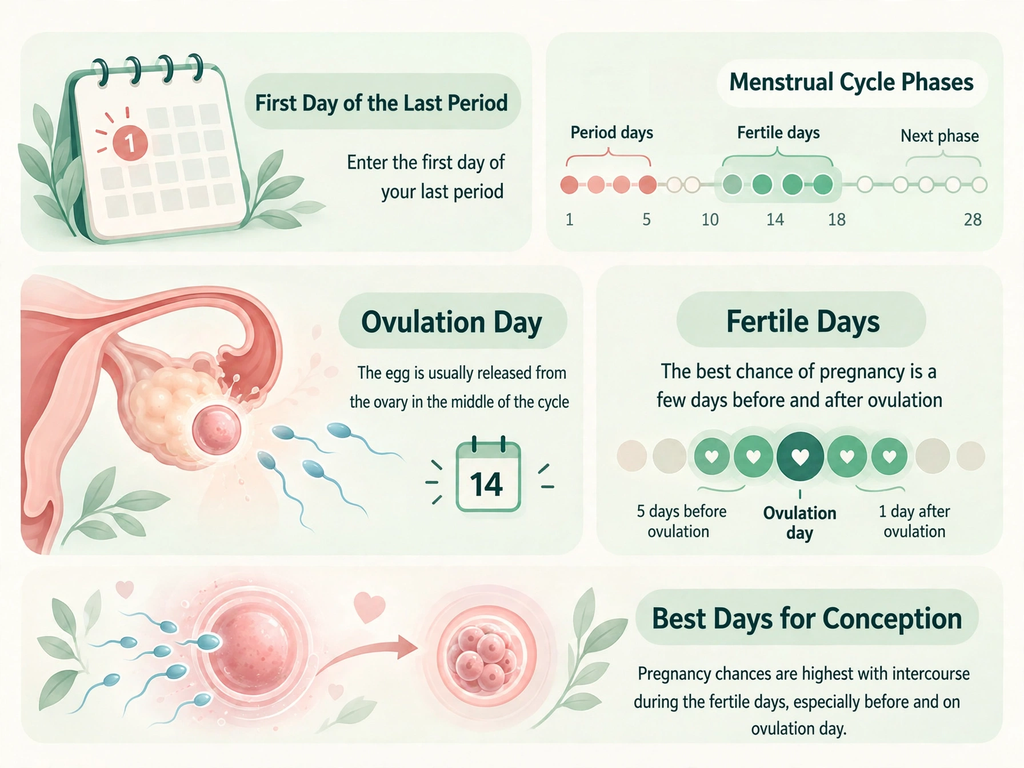
Calculator results are estimates for informational purposes only and do not replace medical advice. Actual period and ovulation dates may vary. Do not rely on this calculator to confirm or prevent pregnancy.
What Will You See in Your Period Calculator Results?
Depending on the options available, the results may show your next expected start date or date range, estimated bleeding days, days remaining until the next period, and corresponding Hijri and Gregorian dates. A color coded calendar, future cycle predictions, and approximate ovulation and fertility dates may also appear. Predicting the next period remains the main purpose of this page.
By the working “Download PDF” button in the results panel, you can save a copy of the result. Ideally, the downloaded document should preserve the on screen layout and colors. Predictions six or twelve cycles into the future should be presented as estimates that may change, not guaranteed dates.
How Is the Next Menstrual Period Date Calculated?
A menstrual cycle starts on the first day of bleeding and ends the day before the next period begins. For a regular cycle, add your usual cycle length to the starting date of your last period. This is the basic method for calculating the menstrual cycle and helps avoid confusing bleeding duration with the full cycle length.
Estimated next period date = First day of the last period + Cycle length in days
For example, if your last period started on 1 October 2026 and your cycle is 28 days long, the next period is estimated to begin on 29 October 2026. If bleeding lasts five days, the estimated bleeding dates are 29 October to 2 November. These dates are illustrations; periods may begin a little earlier or later even when cycles are usually regular.
Next Period Dates by Cycle Length
The following table compares expected dates for cycles starting on 1 October 2026. These are calendar examples for regular cycles, not diagnoses or guaranteed dates.
| Cycle length | Expected next period date |
|---|---|
| 24 days | October 25, 2026 |
| 26 days | October 27, 2026 |
| 28 days | October 29, 2026 |
| 30 days | October 31, 2026 |
| 32 days | November 2, 2026 |
| 35 days | November 5, 2026 |
Period Calculator with Hijri and Gregorian Dates
The Hijri period calculator option lets you enter or view a predicted date using the Umm al Qura calendar used in Saudi Arabia. You can also choose Gregorian dates. Switching calendars changes only how a date is written or displayed; it does not change the number of days in your cycle or when bleeding occurs.
Check the start date carefully when switching calendars, especially close to the beginning or end of a Hijri month. If you use combined Hijri period and ovulation predictions, remember that the Hijri ovulation date is still a calendar estimate, not proof that ovulation occurred.
What Is the Difference Between Cycle Length and Bleeding Duration?
Cycle length is the number of days from the start of one period to the start of the next. Bleeding duration is the number of days the menstrual bleeding itself lasts. For example, a menstrual cycle may last 28 days while bleeding lasts only five days. In this case, enter 28 for cycle length and 5 for bleeding days, not the other way around.
Not everyone has a 28 day menstrual cycle. Length varies between people and may change somewhat from one month to another. For many adults, cycles are roughly 21 to 35 days long, while bleeding commonly lasts two to seven days. Patterns also vary with age and health, so look at your own recorded dates rather than comparing yourself only with an average.
How Are Period Calculators and Ovulation Related?
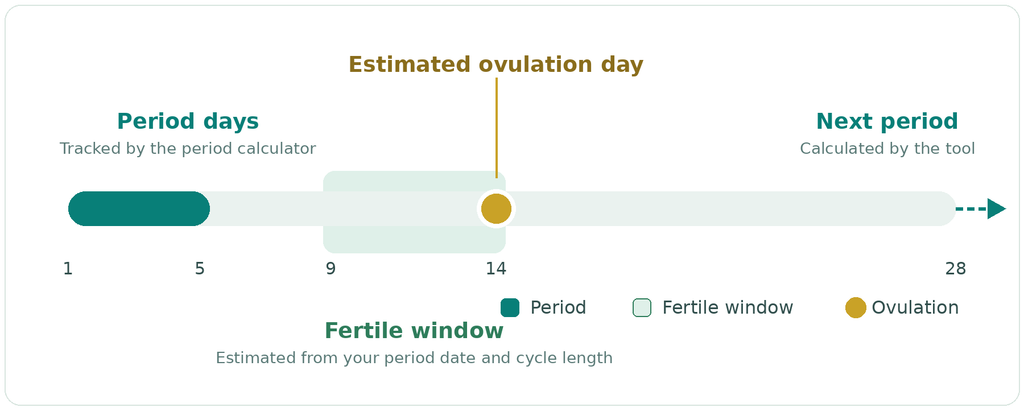
A period and ovulation calculator can provide a calendar estimate of ovulation and the fertile window using the beginning and length of your cycle. With a 28 day cycle and an assumed 14 day luteal phase, ovulation might be estimated on 14 October, with a fertile window from 9 to 14 October. Actual timing may differ, so a predicted ovulation date is not confirmation that ovulation has occurred.
If your main goal is to estimate fertile days after your period, visit the Ovulation and Fertile Days Calculator for a more detailed explanation of fertility windows and irregular cycles. This page concentrates on the next menstrual period, while the other tool focuses on fertility and attempts to conceive.
How Can I Estimate My Next Period with Irregular Cycles?
If you are looking for an irregular period calculator, select “Irregular” and enter your shortest and longest cycles from recent months. The period calculator shows an expected range instead of a single date, because prediction accuracy drops when cycle lengths vary.
For example, if your period started on October 1, 2026, and your cycle length is between 25 and 35 days, your next period may start between October 26 and November 5, 2026. These are estimated dates, and the range may widen in upcoming cycles.
Slight variation does not mean there is a health problem, but it is important to track your cycle regularity and consult your doctor if frequent or noticeable changes occur.
How Are Period Calculators and Ovulation Related?
A period and ovulation calculator can provide a calendar estimate of ovulation and the fertile window using the beginning and length of your cycle. With a 28 day cycle and an assumed 14 day luteal phase, ovulation might be estimated on 14 October, with a fertile window from 9 to 14 October. Actual timing may differ, so a predicted ovulation date is not confirmation that ovulation has occurred.
If your main goal is to estimate fertile days after your period, visit the Ovulation and Fertile Days Calculator for a more detailed explanation of fertility windows and irregular cycles. This page concentrates on the next menstrual period, while the other tool focuses on fertility and attempts to conceive.
Are Any Calendar Days Guaranteed Safe for Avoiding Pregnancy?
No. Dates outside the estimated fertile window cannot be treated as guaranteed safe days for contraception. Ovulation timing can change even when cycles seem regular. Do not rely on a period calculator alone to prevent pregnancy; seek advice about a suitable contraceptive method when needed.
When Can You Take a Pregnancy Test after a Missed Period?
You may want to know both your next period date and whether you could be pregnant, but estimating a period date is not the same as confirming pregnancy. Most home pregnancy tests can be taken from the first day of a missed period. If your cycles are irregular and you do not know when the period was due, testing at least 21 days after the last unprotected sex is another useful guideline. An early negative result does not always rule out pregnancy; follow the test instructions and repeat it if necessary.
The Pregnancy Test and hCG Calculator explains test timing and what different results may mean. If pregnancy is confirmed, the Pregnancy Calculator can help estimate gestational age and the expected due date. A result from this period calculator alone cannot establish whether pregnancy has occurred.
When Should You Seek Medical Advice?
Talk with a clinician if menstrual timing remains irregular, bleeding becomes very heavy, bleeding lasts longer than seven days, you bleed between periods, or severe pain interferes with daily life. Seek urgent medical care if heavy bleeding is accompanied by dizziness or fainting. A period calculator cannot determine the cause of these symptoms.
For reliable medical information about the menstrual cycle and unusual bleeding, read the patient FAQs from the American College of Obstetricians and Gynecologists (ACOG). This can help you understand when professional medical advice may be appropriate.
Frequently Asked Questions
Count the days from the first day of bleeding in one period to the first day of bleeding in the next. Repeat this for several months to understand your average and variation. Do not use the number of bleeding days as the cycle length.
It can provide a useful estimate when the start date and cycle length are correct, but it cannot know for certain when bleeding will begin. Predictions tend to be less certain when cycle lengths change considerably.
Yes. Choose the irregular mode and enter your shortest and longest recent cycle lengths. The calculator can show a possible range instead of one date, with a reminder that the actual date may differ.
Yes, where the Hijri option is available. The Hijri calendar shows an equivalent date and does not change how the prediction itself is calculated.
No. Twenty eight days is a commonly cited average, not a requirement. Compare several months of your own dates and speak to a professional if you notice a large or persistent change.
No. Estimating fertile days can help with planning but does not confirm ovulation or pregnancy. You can read about the ovulation calculator to understand the limits of calendar estimates, but the result is not proof of pregnancy.
If a Download PDF button appears in the results panel, you can save a copy of your dates. Check the information before sharing the file because menstrual dates are personal information.
Not necessarily. Timing can change for many reasons. If pregnancy is possible, use an appropriate pregnancy test rather than relying only on the calculated period date.
Useful Planning Estimates, Not a Diagnosis
The period calculator helps you follow your expected dates and recalculate when a new period begins. Update the inputs when more recent dates are available. A predicted date is not a diagnosis of a menstrual disorder or confirmation of pregnancy. Avoid sharing result links or PDF files if they contain personal menstrual dates.
If the next period begins on a different day, update the date and use the period calculator again so that future estimates reflect your most recent information.
To learn more about the website and how its content is prepared, visit About Us.
Medical Disclaimer: This tool provides estimates and general information only. It does not diagnose pregnancy or menstrual disorders and does not replace professional medical evaluation.
Use our other calculators
You can return to the pregnancy calculator or use the ovulation calculator and Pregnancy Test and hCG Hormone Calculator.