
Ovulation Calculator To Find Fertile Days
Want to know when your chances of getting pregnant may be highest? Start with the date of your last period. Our ovulation calculator uses your cycle length to estimate your ovulation day and fertile window, whether you prefer Hijri or Gregorian dates. The result is an estimate and does not confirm that ovulation has occurred.
Ovulation and Fertility Days Calculator
Estimate your fertile days in Gregorian or Hijri
Enter the day your period started, not the day it ended.
Use your shortest and longest cycles from recent months.
Advanced settings (optional)
Default is 14 days if you do not know it.
Loading the calculator…
Calculations run in your browser; your data is not sent to any server. Results are estimates.
Your ovulation calculation result
Expected calendar
Next three cycles forecast
How are these dates calculated?
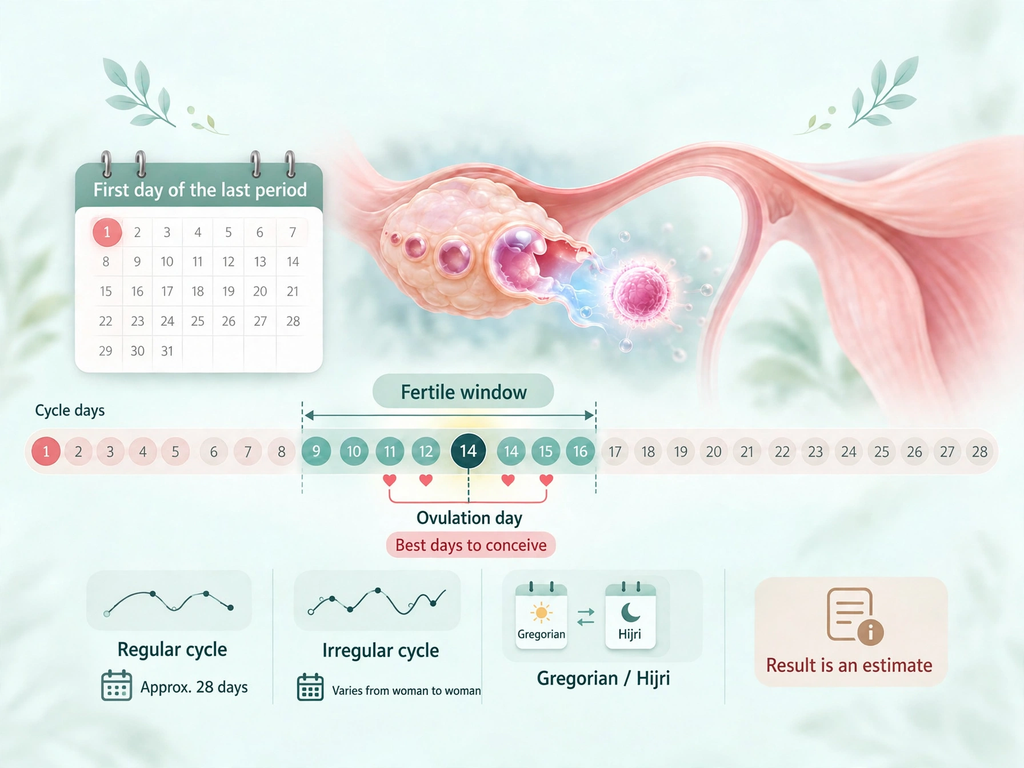
The cycle starts on the first day of bleeding. Ovulation day is estimated by subtracting the luteal phase length from the cycle length, then the fertile window is estimated as the five days before ovulation day plus ovulation day itself. Actual ovulation may differ from this estimate for some women.
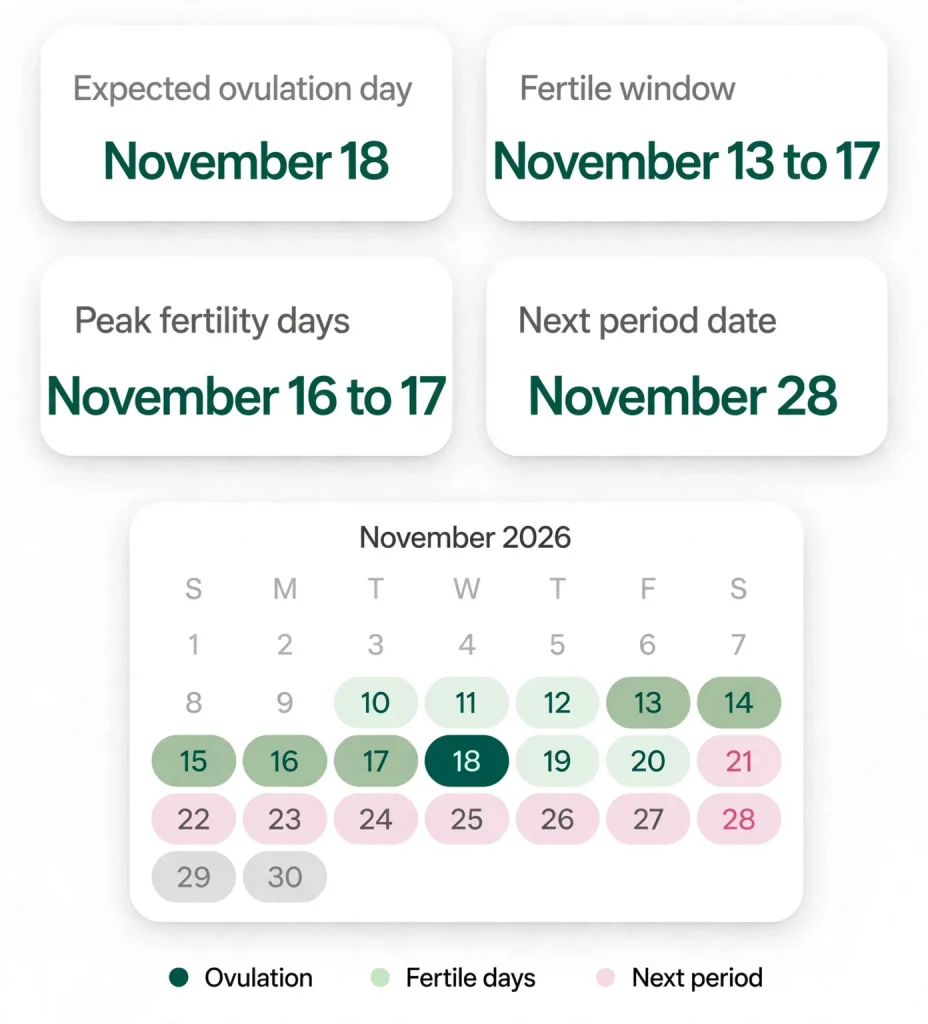
The Ovulation and Fertile Days Calculator shows your expected ovulation date, estimated fertile window, peak fertile days, expected next period and a simple note about how cycle regularity affects the estimate.
What Will Your Results Show?
The ovulation calculator shows your estimated ovulation day, fertile window, days when conception may be most likely, and expected next period. A color-coded calendar makes these different dates easier to distinguish.
If your cycles are irregular, the calculator displays a wider range and explains that the prediction is less reliable. It also provides approximate dates for the next three cycles, with a reminder that the timing can change from month to month.
Use the calendar legend to interpret the colors: one for estimated ovulation, another for fertile days, and a third for the next period. A highlighted date does not guarantee pregnancy on that day.
How Do I Calculate Ovulation Days After My Period?
The ovulation calculator counts days from the beginning of menstruation. Day 1 is the first day of your period. For a calendar-based estimate, the assumed luteal-phase length is subtracted from the cycle length. Fourteen days is commonly used as an initial value, but this phase can vary.
For a 28-day cycle, ovulation is estimated around cycle day 14. For example, if a period begins on October 1, the estimated ovulation date may be around October 14, the fertile window from October 9 to October 14, and the next period around October 29. These dates are illustrative, not confirmed predictions.
Estimates vary with cycle length. If you know your luteal-phase length, you can adjust it in the advanced settings; otherwise, leave the default value in place.
Ovulation Days After Your Period: Reference Table
The following ovulation-day chart compares cycle length with the estimated ovulation day and fertile window. It shows examples for regular cycles with an assumed 14-day luteal phase, not guaranteed dates:
| Cycle length | Approximate ovulation day | Approximate fertile window |
|---|---|---|
| 24 days | Day 10 | Day 5 to day 10 |
| 26 days | Day 12 | Day 7 to day 12 |
| 28 days | Day 14 | Day 9 to day 14 |
| 30 days | Day 16 | Day 11 to day 16 |
| 32 days | Day 18 | Day 13 to day 18 |
| 35 days | Day 21 | Day 16 to day 21 |
Irregular Cycles: Expect a Range, Not a Single Day
When cycle length varies from month to month, predicting ovulation becomes less accurate. The ovulation calculator therefore cannot provide a confirmed date. Your shortest and longest recorded cycles help estimate a possible range, but they do not establish when the egg was actually released.
For example, if your cycles range from 25 to 35 days and a 14-day luteal phase is assumed, ovulation may be estimated between cycle days 11 and 21. The possible fertile window would extend from day 6 to day 21. This is a broad range; it does not mean every day within it is equally fertile.
Calendar calculations become more limited when cycles are highly irregular, with polycystic ovary syndrome (PCOS), during breastfeeding, after childbirth, or when menstruation returns after stopping certain hormonal contraceptives. Ovulation tests or advice from a healthcare professional may help you decide what to do next.
Why Does the Fertile Window Last More Than One Day?
Some people use “ovulation period” to mean the days surrounding the release of an egg, but ovulation itself does not last for several days. Understanding ovulation and intercourse timing is easier when you think in terms of the fertile window. It usually includes the five days before ovulation and ovulation day itself, because sperm can survive for several days. The chance of pregnancy is often highest during the two days before ovulation.
If you are trying to conceive and wondering when to have intercourse, there is no need to wait for a particular hour. Having intercourse every day or every other day during the fertile window may be practical, without pressure or any guarantee of pregnancy.
For more evidence about the timing of fertility, read the American Society for Reproductive Medicine’s recommendations on natural fertility.
Have You Noticed Signs That Ovulation May Be Approaching?
Cervical mucus may become clear and stretchy as ovulation approaches. An LH ovulation test detects a rise in luteinizing hormone that usually occurs beforehand, but the test alone does not confirm that an egg was released.
A rise in basal body temperature generally occurs after ovulation, so it is more useful for recognizing a pattern in previous cycles. Compare these signs with your fertility-calculator estimate, and speak with a healthcare professional if you remain concerned.
If the calendar estimate differs from your LH test results over several cycles, record the dates of your periods, cervical-mucus changes, and test results, then share these observations with your clinician. Tracking patterns can help you understand your cycle without relying on a single date.
Hijri or Gregorian? Choose the Calendar You Prefer
You can calculate ovulation using Hijri dates based on the Umm al-Qura calendar by entering the first day of your last period. If you prefer a Gregorian ovulation calculator, choose a Gregorian date and read the results in that calendar, or change the display according to your preference.
Changing the calendar only changes how the dates are displayed; it does not change the estimated timing of ovulation. Check that your starting date is correct before reading or sharing the results.
Pregnancy Calculator vs. Ovulation Calculator: When Do You Need Each?
Estimating fertile days is different from calculating pregnancy dates. An ovulation calculator helps estimate the fertile window before pregnancy. A pregnancy calculator estimates gestational age and the due date once pregnancy has occurred, usually using the first day of the last menstrual period. Although some websites combine these tools, each serves a different purpose.
If you want to estimate pregnancy dates from ovulation day, a tool that accepts a known or estimated ovulation date may help calculate gestational age approximately. You can review the pregnancy calculator to see which input methods are available. A calculated date cannot establish the exact day fertilization occurred.
You may come across the phrase “pregnancy calculator from ovulation day” when searching online. The important distinction is between estimating an ovulation date and confirming pregnancy. No conception-date calculator can prove that fertilization occurred without a pregnancy test.
When Is a Pregnancy Test Result Useful?
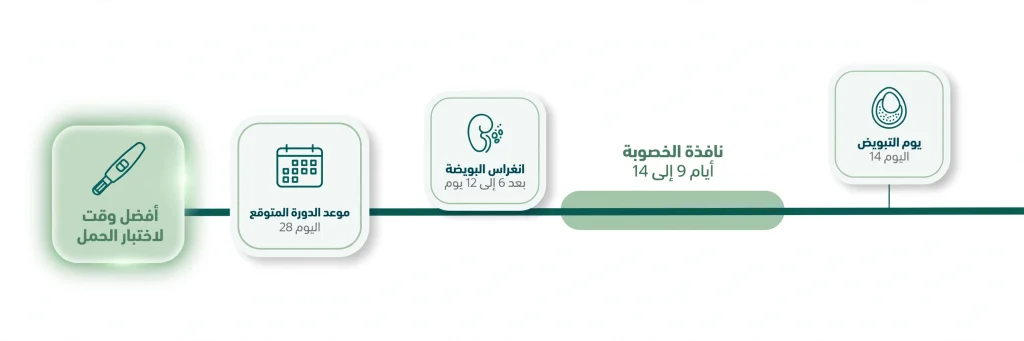
A home pregnancy test is generally more reliable from the first day of a missed period. Testing too early can produce a negative result even if you are pregnant. If you are unsure, repeat the test according to its instructions.
To learn more, visit the pregnancy test and hCG calculator. You can also read about common early pregnancy symptoms, but remember that symptoms alone cannot confirm pregnancy.
Once you have a positive result and pregnancy is confirmed, a step-by-step pregnancy and childbirth guide, along with a pregnancy calendar and journal, can help you follow the stages ahead.
If you use a pregnancy and due date calculator after confirmation, its purpose is to estimate gestational age and the expected due date, not to identify the exact day of fertilization.
Can You Use an Ovulation Calculator to Prevent Pregnancy?
No. An ovulation calculator should not be used as your only method of contraception, because ovulation timing can change even when cycles appear regular. A tool described as a “birth control calculator” or “safe period calculator” cannot guarantee that particular days are safe from pregnancy.
If you want to avoid pregnancy, seek advice about an appropriate contraceptive method rather than relying on calendar calculations alone.
Frequently Asked Questions
The timing of fertile days after a period varies from person to person according to cycle length and the actual timing of ovulation. Estimating ovulation and intercourse timing can help you plan when to try to conceive, but it cannot confirm pregnancy or provide a fixed number of days that applies to everyone.
No. Even with regular cycles, the ovulation calculator provides an estimate. The day an egg is released may vary from month to month, and the calculator does not confirm that ovulation has occurred.
Yes. You may not notice any distinctive cervical mucus or symptoms. The absence of noticeable signs does not prove that ovulation did not occur.
Ovulation is the release of an egg and normally happens once per cycle. The fertile window, however, lasts about six days: the five days before ovulation and ovulation day. Not every fertile day is an actual ovulation day.
There is no reliable method for choosing a baby’s sex by timing intercourse close to ovulation. The calculator can estimate fertile days when you are trying to conceive, but it cannot predict the sex of a baby.
See a healthcare professional if your periods stop, become very irregular, or you continue to have difficulty conceiving. Fertility evaluation is generally recommended after 12 months of trying for women under 35 and after 6 months for women aged 35 or older. An earlier assessment may be appropriate if you have a known health concern.
No. An estimated fertile window does not confirm pregnancy. Confirmation requires an appropriate test and, in some circumstances, medical assessment.
Useful guidance without false precision
The Ovulation and Fertile Days Calculator is designed to help you understand your cycle and identify your likely fertile period without pretending the estimate is exact. If you have ongoing concerns about cycle regularity, ovulation or fertility, medical evaluation is more useful than relying on a calculator alone.
Medical disclaimer: This tool provides estimates and general information only. It does not diagnose ovulation disorders or infertility and should not be used as your sole method of contraception.