Early Pregnancy Symptoms and the Clearest Signs
Pregnancy symptoms may begin mildly, and in some women they may not appear clearly during the first few weeks. Common signs include a missed period, nausea, breast tenderness, fatigue, frequent urination, and changes in smell and taste. However, these signs do not confirm pregnancy on their own. The practical way to check is to take a pregnancy test at the right time.
If you are trying to understand early signs of pregnancy or determine whether the changes you are feeling are related to pregnancy or your period, the most important thing is to consider the timing and nature of the symptoms together with the test result rather than relying on a single symptom.
What Are the Strongest Early Signs of Pregnancy?
For women with regular menstrual cycles, a missed period is one of the most useful early signs, although it is not conclusive on its own. Nausea, breast tenderness, fatigue, frequent urination, and changes in appetite or sensitivity to smells are also common in early pregnancy, but they can occur for other reasons as well.
The NHS explains that early pregnancy symptoms often begin when pregnancy is around 4 to 6 weeks, although every woman’s experience is different.
Therefore, there is no reliable group of symptoms that confirm pregnancy in the first week, and the absence of symptoms does not rule out pregnancy.
You can also browse early pregnancy symptoms in pictures to recognize the most common signs of the first weeks.

Most Common Early Pregnancy Symptoms
You may notice one or more of the following symptoms:
- Increased sensitivity to certain smells or changes in taste.
- Food aversions or cravings.
- Mood changes.
- More vaginal discharge than usual without itching or pain.
- Mild cramps similar to period pain.
- Light spotting or bleeding in some women.
- A missed or delayed period.
- Nausea with or without vomiting.
- Breast tenderness or fullness.
- Unusual fatigue.
- Need to urinate more often than usual
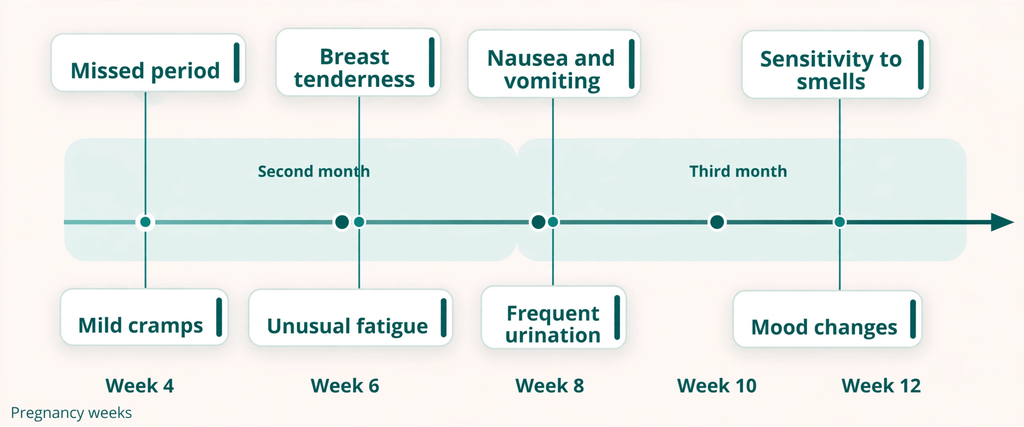
The NHS confirms that every pregnancy is different, so you do not need to experience all of these signs. Some women may notice very few or no obvious symptoms at the beginning.
When Do Pregnancy Symptoms Start?
The timing of symptoms varies. This is why searching for pregnancy symptoms from the first day of fertilisation can give an impression of precision that does not really exist. During the first few days after fertilisation, there is usually no home-observable sign that can reliably confirm pregnancy.
If you are looking for early pregnancy symptoms with illustrations, remember that pictures help understanding but never replace a pregnancy test.
Before Your Period Is Due
Mild changes such as breast tenderness, fatigue, light cramps, or spotting may occur, but these symptoms overlap considerably with premenstrual symptoms.
For this reason, the phrase symptoms that confirm pregnancy before your period is due should be understood cautiously, because symptoms alone cannot provide confirmation.
Around and After the Expected Period
If your period does not begin when expected, pregnancy becomes more likely, especially if other symptoms are present. Symptoms such as nausea, fatigue, changes in smell, or breast changes may also become more noticeable as the first weeks progress.
As for when pregnancy symptoms begin before a missed period, there is no fixed day. Some women may notice changes before their expected period, while others may not feel anything until after the period is late.
Pregnancy Symptoms or Period Symptoms?
It is not always possible to distinguish pregnancy from premenstrual symptoms based on how you feel alone.
For a visual comparison of both, see early pregnancy symptoms alongside the table in this section.
| Symptom | Early Pregnancy | Before Period |
|---|---|---|
| Breast pain | Possible | Possible |
| Bloating | Possible | Possible |
| Mild cramps | Possible | Possible |
| Mood changes | Possible | Possible |
| Fatigue | Possible | Possible |
| Nausea | More linked to pregnancy | Less common |
| Missed period | More indicative | Period usually starts after PMS |
| Positive pregnancy test | Confirms pregnancy | Not caused by PMS |
If the symptoms remain similar, testing is more useful than trying to interpret each symptom individually.
Pregnancy Symptoms in Pictures at a Glance
When searching for pregnancy symptoms in pictures, it is better for the image to show genuine common signs rather than present them as a diagnostic checklist. Areas such as the breasts, lower abdomen, nose, bladder, and digestive system can be highlighted with a short explanation of each symptom.
Any visual material about pregnancy symptoms in pictures should also make clear that a missed period, nausea, breast tenderness, fatigue, frequent urination, changes in smell, and vaginal discharge may occur in early pregnancy, but they do not confirm pregnancy without a test.
Are Vaginal Changes and Discharge Signs of Pregnancy?
Vaginal discharge may increase in early pregnancy. The NHS states that an increase in discharge without pain or irritation may be one possible early sign.
However, the term vaginal pregnancy symptoms does not mean that every vaginal change indicates pregnancy.
If the discharge is accompanied by itching, pain, an unusual smell, or an unusual colour, the cause may be something else and should be assessed rather than assumed to be pregnancy.
You can view early pregnancy symptoms in pictures to tell normal early discharge apart.
Where Does Pain Occur in Early Pregnancy?
Mild cramps may occur in the lower abdomen or pelvis and can feel similar to period pain. Breast tenderness may also occur.
As for whether back pain is an early sign of pregnancy, back pain can occur during pregnancy, but it is a non-specific symptom and should not be used as a way to determine whether pregnancy is present. ACOG explains that back pain is common during pregnancy and may have several causes.
Severe or persistent pain, especially if it is on one side or accompanied by bleeding, dizziness, or fainting, needs prompt medical assessment.
What Does “Weak Pregnancy” Mean and What Are Its Symptoms?
This phrase is commonly used in searches, but it is not a diagnosis that can be determined from symptoms at home. The disappearance of nausea, changes in breast tenderness, or having mild symptoms do not by themselves prove that the pregnancy is not progressing normally.
Assessing whether a pregnancy is continuing normally or whether it is located correctly may require medical history, examination, ultrasound, and/or appropriate blood tests depending on the situation. Therefore, symptom intensity should not be used to judge the health of a pregnancy.
Can Pregnancy Occur Without Symptoms?
Yes. Some women experience several early symptoms, while others notice only one or two. Some may go through the first few weeks without any obvious changes.
The absence of nausea or breast tenderness, for example, does not rule out pregnancy. The NHS explains that not noticing symptoms in the first few weeks does not necessarily mean that pregnancy is not present.
For this reason, the strength or health of a pregnancy should not be judged by the number or intensity of symptoms.
Is Diarrhoea a Pregnancy Symptom?
Diarrhoea is not one of the main signs used to determine whether pregnancy has occurred. It may happen because of dietary changes, infection, or other digestive causes, so it should not be interpreted on its own as evidence of pregnancy.
If it is severe, persistent, or causes signs of dehydration, the important step is to evaluate the underlying cause.
Is Nasal Sensitivity a Sign of Pregnancy?
Nasal congestion or other nasal changes can occur during pregnancy, and the Saudi Ministry of Health lists nasal congestion among the possible changes during pregnancy.
However, sneezing or nasal sensitivity alone is not considered a reliable sign for diagnosing pregnancy.
I Have Symptoms but the Test Is Negative. What Should I Do?
If the test was taken before your expected period or very close to that date, it may simply be too early. Repeat the test after a few days if your period still has not started.
If repeated tests remain negative and your period does not begin, or if your symptoms are severe or unusual, it is appropriate to seek medical advice rather than continuing to rely only on home testing.
When Should I Take a Pregnancy Test?
A pregnancy test is the practical next step when pregnancy is possible. The FDA explains that testing too early may produce a false-negative result because hCG levels may not yet have risen enough.
It also notes that 10 to 20 pregnant women out of every 100 may not receive a positive result on the first day of a missed period.
If the test is negative and was taken early, it can be repeated after a few days if the period has still not started. Using first-morning urine and following the test instructions carefully may also help.
To determine the best timing for you, use the pregnancy test and hCG calculator rather than relying on symptoms alone.
When Do Symptoms Need Medical Attention?
Some symptoms need prompt assessment, especially if pregnancy is possible.
If you notice worrying signs after reviewing early pregnancy symptoms in pictures, seek medical care promptly.
Seek medical care if you experience:
- Noticeable bleeding.
- Severe or persistent abdominal or pelvic pain.
- Severe pain on one side.
- Severe dizziness or fainting.
- Vomiting that prevents you from keeping food or fluids down.
For more from a trusted medical source, see the Mayo Clinic guide to early pregnancy symptoms.
The Saudi Ministry of Health states that severe vomiting accompanied by reduced urination, very dark urine, severe weakness, dizziness, or weight loss requires medical assessment.
Quick Questions
For women with regular menstrual cycles, a missed period is generally more useful than most other symptoms, but pregnancy is confirmed with a pregnancy test.
There may be mild cramping in the lower abdomen or pelvis similar to period pain. Severe or persistent pain, or pain accompanied by bleeding, requires assessment.
Nasal changes and congestion may occur during pregnancy, but they are not reliable signs for determining whether pregnancy is present.
It is not a reliable sign for confirming pregnancy because it can have many other causes.
Symptoms Give a Clue, but the Test Gives the Answer
Early signs of pregnancy may raise suspicion that pregnancy is present, but they cannot confirm it. Monitor the timing of your period, choose an appropriate time for testing, and treat severe pain, bleeding, or severe vomiting as reasons to seek care rather than simply as pregnancy symptoms.
If you want to see the signs in a simple format, a pregnancy symptoms in pictures section can be used as a visual summary, while a pregnancy test remains the clearest step for confirmation.
Medical Disclaimer: This content is for educational and general informational purposes only and does not replace professional medical diagnosis or care.