
Twin Pregnancy Guide
Some people carrying twins experience stronger nausea, breast tenderness or fatigue, but symptoms and home pregnancy tests cannot confirm that two babies are present. Ultrasound is the main way a multiple pregnancy is identified, after which the type of twin pregnancy and the placental arrangement become important for planning care.
A twin pregnancy calculator may help calculate gestational age or an estimated due date, but it cannot tell you how many babies are present or whether both babies are growing normally.
How does a twin pregnancy happen?
Fraternal twins develop when two separate eggs are fertilised. Identical twins develop when one fertilised egg divides into two embryos.
The Saudi Ministry of Health notes that fertility medicines and assisted reproductive techniques can increase the likelihood of multiple pregnancy. Maternal age is also associated with a greater chance of releasing more than one egg in a cycle.
A simple how twin pregnancy happens visual can explain this much more clearly than myths about symptoms or body shape.
Who is more likely to have twins?
Factors associated with a greater chance of fraternal twins include fertility treatment, some assisted reproduction techniques, increasing maternal age and certain family patterns.
There is no proven home method for conceiving twins that guarantees a twin pregnancy. Likewise, searches for a method to conceive twins or ovulation days for twins should not be interpreted as evidence that certain intercourse days can guarantee the release and fertilisation of two eggs.
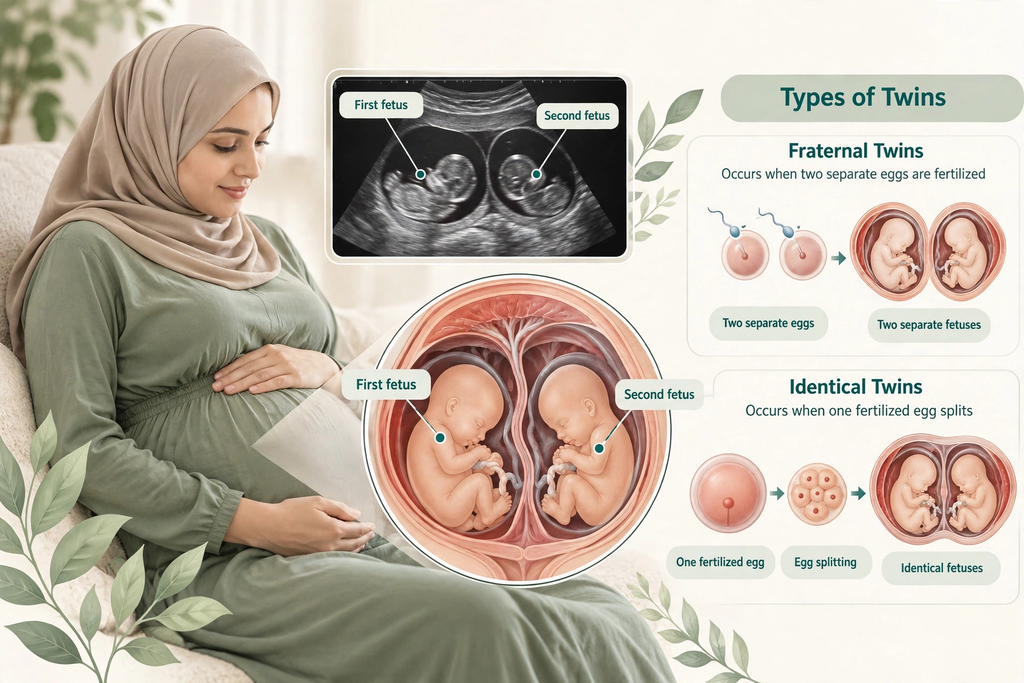
How can I tell if I am pregnant with twins early?
Symptoms alone cannot provide the answer.
Nausea, breast tenderness, tiredness or faster weight gain may sometimes be more noticeable in a multiple pregnancy, but the same symptoms can occur with one baby. The Saudi Ministry of Health states that most multiple pregnancies are identified by ultrasound.
A home pregnancy test detects hCG when enough of the hormone is present. It cannot reliably tell you whether there is one fetus or two.
When can twins be seen on ultrasound?
More than one fetus may be seen during an early ultrasound, although exactly when this is clear depends on gestational age and the quality and circumstances of the scan.
Once twins are seen, ultrasound is also used to determine whether they share a placenta or amniotic sac. NICE recommends determining chorionicity and amnionicity when a multiple pregnancy is identified because these findings affect follow-up.
Searches such as when did your twins show on ultrasound describe personal experiences rather than a fixed medical date. Finding out about twins in the first month may be possible in some pregnancies, but a repeat scan may occasionally be needed when the pregnancy is extremely early.
Are twin pregnancy symptoms different?
Symptoms can be stronger for some people, but there is no symptom pattern that reliably diagnoses twins.
Online searches for twin pregnancy symptoms from other mothers or twin pregnancy symptoms in the first week often reflect personal experiences. They should not be used as proof that two babies are present.
Likewise, twin pregnancy signs before a missed period cannot reliably distinguish twins from a singleton pregnancy or ordinary premenstrual symptoms.
What is twin-pregnancy discharge like?
Vaginal discharge can increase during pregnancy, but there is no specific discharge pattern that confirms twins.
Discharge associated with an unusual smell, itching, pain or an unusual colour may have another cause and should not simply be attributed to carrying twins.
Is diarrhea a sign of twin pregnancy?
No reliable diagnostic relationship allows diarrhea to identify a twin pregnancy. Diarrhea has many possible causes, including infection, diet and gastrointestinal conditions.
Persistent or severe diarrhea should be considered on its own merits rather than interpreted as evidence of twins.
Can a pregnancy test be negative and twins later be found?
Yes. A home pregnancy test can be negative when it is performed too early, before hCG has reached the test’s detection threshold.
A story such as negative pregnancy test and later found to be carrying twins does not mean an early negative result predicts twins.
Online forum experiences can be useful for emotional support, but they should not replace medical evidence. A dark test line or a high hCG number also cannot reliably count the number of fetuses.
Twin types and why the placenta matters
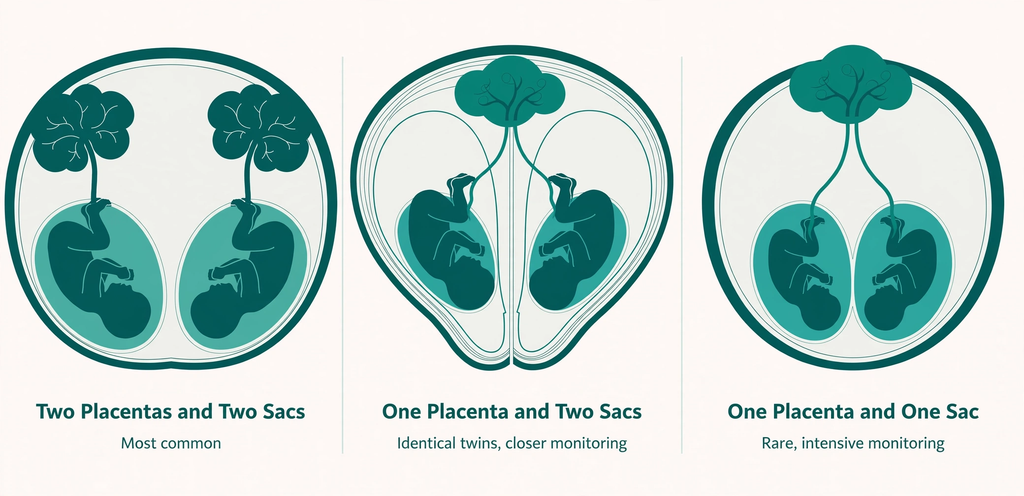
After twins are confirmed, one of the most important questions is whether they share a placenta or amniotic sac.
NICE recommends establishing chorionicity and amnionicity because these features influence the risks and monitoring plan.
| Type | Simplified Meaning |
|---|---|
| DCDA | Each fetus has a separate outer membrane and amniotic sac, and the placentas are usually separate. |
| MCDA | The twins share one placenta but have separate amniotic sacs. |
| MCMA | The twins share one placenta and one amniotic sac. |
ACOG notes that twins sharing a placenta are linked to some additional risks, which is why they need closer monitoring.
How is twin pregnancy monitored?
Twin pregnancies generally need more ultrasound and clinical monitoring than singleton pregnancies.
For week-by-week tracking of a single pregnancy, you can also follow our step-by-step guide.
Doctors may monitor each baby’s growth, amniotic fluid, maternal blood pressure and other aspects of maternal and fetal health. Twins sharing a placenta usually need closer surveillance.
A twin pregnancy calculation tool or calculator for twins cannot determine whether growth is balanced or identify placental complications. These require ultrasound and clinical follow-up.
NICE recommends closer monitoring for monochorionic twins, including surveillance for complications such as twin-to-twin transfusion syndrome and fetal growth problems.
For more from a trusted medical source, see the Mayo Clinic guide to twin pregnancy.
Do twins need to weigh the same?
No. Their estimated weights do not have to be identical.
Clinicians are more interested in each baby’s growth pattern and whether an important difference develops between them. A meaningful growth difference may lead to more frequent ultrasound assessment.
What is twin-to-twin transfusion syndrome?
Twin-to-twin transfusion syndrome, or TTTS, can occur when twins share a placenta and blood flow between them becomes unbalanced.
It does not occur in every twin pregnancy, but it is one reason monochorionic twins require closer monitoring. ACOG identifies TTTS as an important complication of twins sharing a placenta.
Nutrition and folic acid
Nutritional requirements and recommended weight gain may differ in a multiple pregnancy. Advice should take account of prepregnancy weight, medical history and the clinician’s recommendations rather than relying on a single calorie or kilogram target from the internet.
Searches such as took folic acid before pregnancy and conceived twins do not establish folic acid as a proven way to create a twin pregnancy. Folic acid is recommended because adequate intake before and during early pregnancy helps prevent neural-tube defects.
Can symptoms tell whether the twins are boys or girls?
There are no reliable home symptoms that identify signs of twin boys or signs of twin girls.
Belly shape, nausea severity, appetite, skin changes and fetal heart rate are not reliable methods of determining the sexes of twins.
What symbols indicate a twin pregnancy?
There are no body symbols, dreams or home signs that medically confirm twins.
If you mean abbreviations on an ultrasound report, terms such as DCDA, MCDA and MCMA describe the placental and amniotic arrangement. They are not symptoms that can be detected at home.
When should someone carrying twins seek urgent care?
Seek medical assessment for significant bleeding, leaking fluid, severe or persistent abdominal pain, regular painful contractions too early, severe headache with visual changes, fainting, severe shortness of breath or a concerning change in fetal movement once movement patterns are established.
Multiple pregnancy carries a greater likelihood of preterm birth and some maternal and fetal complications, making regular clinical follow-up particularly important.
When are twins usually delivered?
Twins are commonly born earlier than singleton babies, but there is no single delivery week that applies to every twin pregnancy.
For uncomplicated pregnancies, NICE recommends planned birth at 37 weeks for DCDA twins, 36 weeks for MCDA twins, and between 32 weeks and 33 weeks 6 days for MCMA twins. Complicated pregnancies require individual planning.
Does twin pregnancy automatically mean a caesarean?
No.
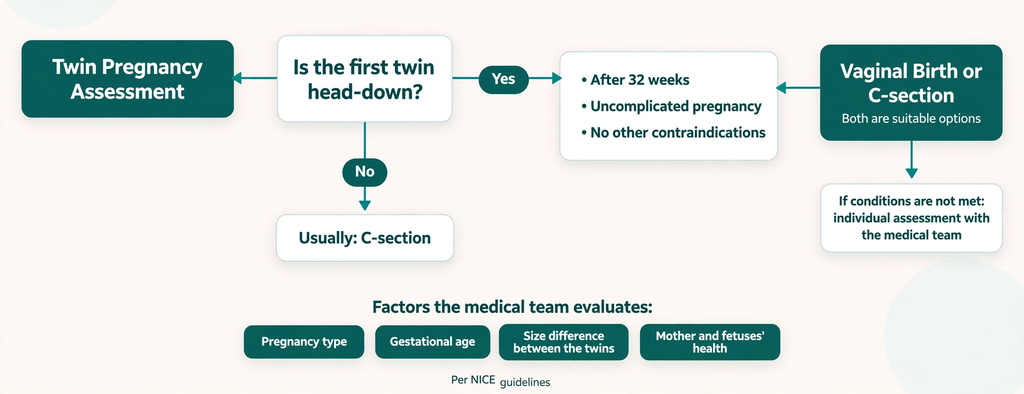
Some twin pregnancies can have a planned vaginal birth, while caesarean delivery is more appropriate in others. The decision can depend on the position of the first baby, gestational age, differences in fetal size, pregnancy complications and maternal and fetal health.
NICE states that planned vaginal birth and planned caesarean can both be appropriate options in certain uncomplicated twin pregnancies after 32 weeks when the first baby is head-first and there are no other contraindications.
Quick Questions
No. A home test detects hCG; it does not reliably count fetuses. Ultrasound is needed to identify twins.
No specific ovulation days guarantee twins. Fertile-window timing may help with trying to conceive generally but cannot determine how many embryos will develop.
Yes. Symptom severity varies considerably and cannot reliably distinguish a twin pregnancy from a singleton pregnancy.
What matters most
Do not rely on strong symptoms, home-test lines or internet experiences to determine whether you are carrying twins.
Ultrasound confirms the pregnancy, identifies the placental and amniotic arrangement, and provides the information needed to plan monitoring. Pregnancy calculators are useful for dates; ultrasound and clinical care are what answer the twin-specific questions.
Medical disclaimer: This content is for general education only and does not replace personalised assessment or follow-up from a qualified healthcare professional.